
Why Manage Six Vendors When You Could Manage One?
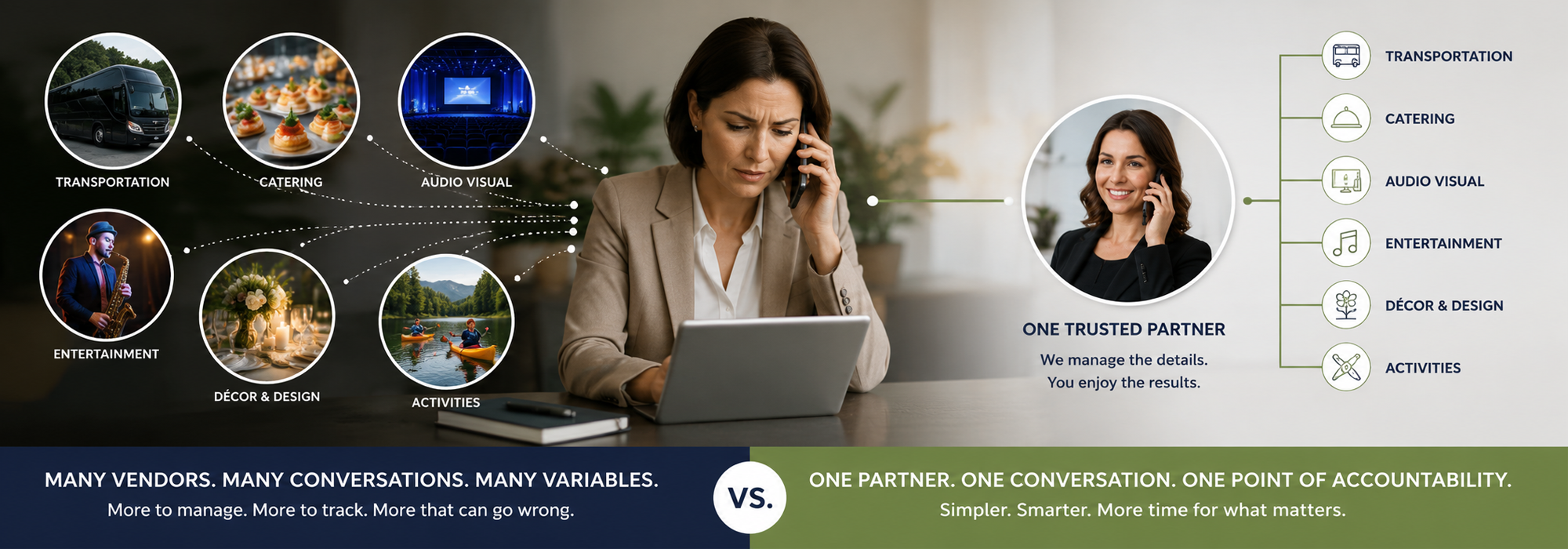
The agency model isn't just for Fortune 500 companies.
When a large corporation brings hundreds of employees or customers into an unfamiliar city for a meeting, conference or incentive program, they rarely ask their internal team to find and manage every local supplier themselves. They hire someone who already knows the market.
It would be easy to assume that's simply because they have the budget to do it. But there's another reason: they understand the value of time, expertise and accountability. And those benefits aren't reserved for organizations with Fortune 500 budgets.
Think Of It Like Hiring A General Contractor
Imagine renovating a building. You could independently find the electrician, plumber, carpenter, painter and flooring contractor. You could negotiate every agreement, coordinate every schedule, process every invoice and figure out which contractor needs to fix the problem when something doesn't go according to plan. Or you could hire a general contractor who manages those relationships for you.
The same concept applies to meetings and events. Transportation. Entertainment. Activities. Décor. Rentals. AV. Photography. Off-site venues. Restaurants. Staffing. Each individual need may be relatively straightforward. Put them together, though, and suddenly your team is managing six, eight or twelve different suppliers, each with separate contracts, contacts, deadlines, payment terms and expectations.
A meeting or event agency can sit between the organization and those suppliers, giving the client one primary partner instead of a collection of vendors. That alone can have significant value.
Procurement Has A Cost, Too
Vendor pricing tends to get most of the attention when organizations compare costs. But procurement itself isn't free.
Someone has to research potential suppliers. Someone has to request proposals, compare them, negotiate terms, collect paperwork, process contracts, coordinate payments and communicate changes. Multiply that by six or eight suppliers and what looked like a less expensive approach can consume a surprising amount of staff time.
This is one reason larger organizations frequently consolidate services through an agency. They're not necessarily paying someone else because they can't do the work. They're deciding that their people's time is better spent somewhere else. Smaller organizations should be able to make that same calculation.
Google Can Find Vendors. Local Expertise Finds The Right Ones.
There's another challenge when you're planning an event somewhere you don't know well. You don't know what you don't know.
A search can give you a list of transportation companies, restaurants, entertainment options and attractions. Reviews can help. Hotel recommendations can help. But none of those necessarily tell you who consistently performs well for groups.
They don't tell you which restaurant has a fantastic private room tucked upstairs, which transportation company has the best vehicles and drivers, which local musician is perfect for an opening reception or which experience guests will still be talking about on the flight home. Those are often the things you learn by working in a destination, building relationships and knowing who to call.
And sometimes the best experience isn't the one with the best search ranking. It's the one you wouldn't have known to search for in the first place.
When Something Goes Wrong, Make One Call
Events rarely go exactly according to plan. A vehicle is delayed. Weather changes. A supplier misunderstands an arrival time. Attendance shifts. Equipment fails. Plan A suddenly needs to become Plan B.
When an organization has independently contracted with multiple suppliers, its team can find itself in the middle trying to determine who needs to fix the problem. With one partner overseeing those pieces, the conversation becomes much simpler: Make one call.
The client shouldn't have to referee suppliers or determine whose responsibility a problem is. The agency coordinates the solution and keeps the program moving. That accountability may be one of the least visible benefits of the model; right up until the moment you need it.
We Saw This Play Out Recently
M3 recently provided onsite support for an organization that had independently contracted with several different suppliers for its event. As we worked alongside their team, we realized something: they didn't need to manage all of those relationships themselves.
They could have contracted with M3 for the broader scope, and we could have sourced and coordinated many of those suppliers on their behalf. The individual services wouldn't necessarily have changed. What would have changed was the client's workload.
Instead of managing multiple procurement processes, contracts, vendor communications and logistics, they could have managed one relationship—and allowed us to manage the rest. That's not about making an event more extravagant. It's about making the process more efficient.
This Isn't Just A Big-Company Strategy
Perhaps that's the biggest misconception. Using an agency, meeting management company or trusted local partner can sound like something reserved for enormous conferences and incentive trips with equally enormous budgets. It isn't.
In fact, organizations with smaller teams may have an even stronger reason to consider the model because they have fewer people available to spend hours sourcing and managing individual suppliers.
The question shouldn't simply be: "Could we do this ourselves?" Of course you could.
The better questions are:
Is this the best use of our team's time?
Do we know this market well enough to find the best options?
And how many different vendors do we really want to manage?
Sometimes adding one partner to the process can dramatically reduce the number of people you have to deal with.
The M3 Approach
At M3, our job isn't simply to add another layer between our clients and their suppliers. It's to remove layers of complexity.
Whether we're managing an entire meeting or event, sourcing individual services or serving as the local resource for a program coming into our region, we look at the bigger picture: What does the client actually need to accomplish, and what's the simplest way to get them there?
Because a successful event shouldn't require your team to become experts in every destination, every supplier category and every logistical detail. Sometimes you just need one good partner who already is.
If you’d like to learn more about removing complexity and enhancing the impact of your event, contact us.
Cheers,
Kelly